Wednesday, 15 November 2023

Soul Survivor donated £53,000 to a charity led by one of their trustees

In the last post I looked at how Soul Survivor worked with Tearfund on a project called Soul Action. And, I asked questions about David Westlake's role as a Soul Survivor trustee. 

But there's more to say about both Soul Action and Westlake. 

Tearfund ended their involvement in Soul Action in 2016. But the project continued. In this era Soul Survivor funded campaigns like Slum Survivor themselves. In these latter years the mechanism for decisions about the grants also changed:

"Having now ended the partnership with Tearfund in respect of the Soul Action project, the allocation of funds now rests with the Soul Survivor leadership team and trustees"

(Source: Group of companies' accounts made up to 31 December 2017, Soul Survivor filings at Companies House, page 51)

The trustees of Soul Survivor were:

  • Ali Martin
  • Andy Croft
  • Christopher Lane
  • David Westlake
  • Graham Cray
  • Jessica Jones
  • Keith Johnson
  • Tim Hughes (until January 2018)

And the Executive Directors were:

  • Duncan Layzell
  • Mike Pilavachi (until September 2019)

The Soul Action restricted fund still existed as before: ring-fenced funds with money going in and out each year.

Grants go out. They're larger amounts, to fewer organisations, than in the Tearfund years.

And there's one particular grant that caught my eye. In 2019 Soul Action made a grant of £53,366 to an organisation called the International Justice Mission:


Grants payable

(Source: Group of companies' accounts made up to 31 December 2019, Soul Survivor filings at Companies House, page 39)

That's a new name; I've not seen it before anywhere in the filings of the Soul Survivor charity. Which is unusual, as normally one sees organisations feature multiple times in these reports. 

In another unusual move, no explanation is given of their work. Remember how in the previous post, I said that most recipients got a paragraph explaining what they do? That's absent here.

Fortunately I happened upon that name some months ago. So, I know that that International Justice Mission are a:

 "global organisation working to protect those living in poverty from violence, slavery. trafficking and other forms of abuse"

And, guess what? Their CEO is none other than David Westlake. 

Yes, David Westlake the Soul Survivor trustee.

In 2019 Soul Survivor leaders and trustees donated £53,366 to a charity led by one of them. 

Westlake joined International Justice Mission UK (IJMUK) in November 2016, as recorded in the filings at Companies House for that year:

"after a lengthy search, we were delighted to secure David Westlake as our new CEO from November 2016"
(Source: Total exemption full accounts made up to 31 October 2016, IJMUK Filings at Companies House, page 7)

This is a conflict of interest. Was this donation in the best interests of Soul Survivor? Or was it in the best interests of International Justice Mission?

Westlake would have had a responsibility to declare such a conflict. Did he?

The leaders and trustees of Soul Survivor will have had a responsibility to spot and deal with such conflicts of interest. Did they? 

The signs don't look good. Unlike with the Tearfund relationship, IJMUK isn't listed in the related party transactions section of the Soul Survivor 2019 filing. And the scant details of this transaction point to a report author who doesn't want to shout about the grant.

In fact, I think the lack of listing of this relationship breaks charity commission rules. Those rules say:

"disclosure must be made of transactions involving trustees, related parties, staff renumeration and ex-gratia payments"

(Source: The Charities Statement of Recommended Practice (SORP), page 86 )

This payment happened in 2019, a year when all sorts of unexplained things happened with the finances of Soul Survivor.

Which of the Soul Survivor leaders and trustees suggested this payment?

Which of the leaders and trustees approved this payment?


This discovery made my look again at the work of Soul Action. The project had its own brand, presumably created by Soul Survivor. And this brand was used on social media channels for Soul Action.

Soul Action Twitter account

When you look closely at the posts on the Twitter channel, it seems like David Westlake was making many of the posts:


And I can't help but notice that, after his move to IJMUK, the Soul Action Twitter feed advertised job opportunities at that charity:


And also plugged IJMUK events:

IJM National Prayer Gathering

And promoted IJMUK campaigns:

Now, it's okay for a charity to promote the work of another charity with similar aims. The problem here is a trustee driving the cross-promotion when they are the paid CEO of the other charity. Don't they gain when their charity receives more promotion?

It's possible another person made these posts. But it's hard to imagine Westlake didn't see them. He could have asked for them to be taken down.

Thursday, 2 November 2023

Questions about the relationship between Soul Survivor and Tearfund

If you ever went to a Soul Survivor festival, I'm sure you heard the name 'Tearfund'. And yet little has been said this year about the connection between the charities. I've looked closely at the annual reports, and I have questions... questions that centre around Soul Action.

Soul Action was a partnership between Soul Survivor and Tearfund. It was run from within the Soul Survivor charity. There are mentions of it in the annual filings, beginning in 2005 with this:

"In the summer of 2005 the charity started Soul Action, an initiative with a social action emphasis to serve the last, the least and the lost. During the year over 700 people and 90 groups joined as Soul Action partners. The first project for Soul Action is Soul in the City 2009 and funds raised to date have been utilised establishing Soul Action, providing educational resources for partners and starting to establish projects and a network in Durban itself. Amounts remaining in restricted funds (note 16) will be used for projects in Durban. In 2006 that charity has partnered Soul Action with Tear Fund and in the summer 50 people will be going to Durban to help with projects."

(Source: Group of companies' accounts made up to 31 December 2005, Soul Survivor filings at Companies House, page 1)

A 'restricted fund' is a familiar term in the charity world. It's a ring-fenced pot of money that can only be used for a particular purpose. It's an administrative hassle, so it's normally only used where a donor has attached conditions to a gift. 

We find details of spending on Soul Action later in the same 2005 report (see the penultimate line):

Soul Action £49,545

(Source: Group of companies' accounts made up to 31 December 2005, Soul Survivor filings at Companies House, page 12)

Side note: I'm confused by the money listed in the 2004 column for Soul Action, because there's no mention of Soul Action in the 2004 filing. Maybe it was renamed for this year.

In the restricted funds section of the 2005 report we can see another entry for the same money going out (it's the figure listed in brackets):


(Source: Group of companies' accounts made up to 31 December 2005, Soul Survivor filings at Companies House, page 16)

That page is giving us details of ring-fenced funds. It shows us there was no money in the Soul Action pot at the beginning of 2005, some money came in, some money went out, and there was £51,009 in the pot at the end of the year.

Where did the money come from? What did that money get spent on? No details are given. I don't think it goes to Tearfund - I think they'd have to explicitly label that.

The setup evolves slightly over the years. In the 2006 report the connection with Tearfund seems to have become more permanent. The connection is now listed in the 'Relationships with other organisations' section of the report (see page 2):

Soul Survivor works with Tear Fund in Soul Action

The connection remains listed in this way for the next 10 years of filings of Soul Survivor.

Later in the 2006 Soul Survivor report we find mention of the first grant made (on page 3):

"During the year a grant of £10,000 was made to the Father's Heart Foundation, a charity in Durban that supports orphans by paying for health checks, school feeds, food packages and extended family support. Amounts remaining in restricted funds (note 18) will be used for projects in Durban."

This is impressive work to support. It seems to echo the issues that Jesus preaches about in the gospel books. So why am I talking about Soul Action?

David Westlake. That's why.


Misplaced loyalty?

Westlake had a long association with Soul Survivor. As he explained in a festival talk in 2019 (at the 0:44 point), he was involved in setting up the first Soul Survivor in the early 90s. 

Westlake was also one of the first group of trustees when the Soul Survivor charity was founded in 2000. His details are on page 4 of the incorporation document of that charity.

He remained a trustee for 20 years, making him almost the longest-serving trustee; Graham Cray served for one month longer. Here is his listing from the officers page of the Companies House entry for Soul Survivor.


Regular readers will know about trustees. But for those who are new, the Charity Commission says:

"Trustees have independent control over, and legal responsibility for, a charity’s management and administration."

Trustees have a legal duty to act in a charity's best interests.

So, David Westlake had a legal duty to act in Soul Survivor's best interests.

Which is complicated, because in 2005 David Westlake was also a staff member of Tearfund. 

Here he is listed on the Leadership Team of Tearfund in the 2004-2005 filing:


(Source: Group of companies' accounts made up to 31 March 2005, Tearfund filings at Companies House, page 27)

Let's unpack that a little.

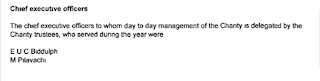
The filings of Soul Survivor tell us that Mike Pilavachi and Liz Biddulph were Chief Executive Officers of Soul Survivor in 2006:


(Source: Group of companies' accounts made up to 31 December 2006, Soul Survivor filings at Companies House, page 2)

How does David Westlake hold Mike Pilavachi accountable... when Soul Survivor is working with his employer Tearfund? 

And, are Tearfund the best organisation for Soul Survivor to work with, compared to a charity like Worldvision or Toybox, or has that decision been swayed by the fact that a Tearfund staff member is a trustee?

I think this is what the Charity Commission call a 'conflict of loyalties'. They define this as:
"a particular type of conflict of interest, in which a trustee’s loyalty or duty to another person or organisation could, or could be seen to, prevent the trustee from making a decision only in the best interests of the charity"

Some important questions arise in this situation: 
  • Was the conflict recognised? 
  • Was the conflict dealt with appropriately?
That's not just Westlake's responsibility, that's the responsibility of all of the trustees at that time:
  • Graham Cray (chair)
  • Christopher Lane
  • David Poultney 
  • Joyce Willis
  • Kevin Johnson
  • Peter Maskrey
One way to deal with the conflict of loyalty would be to distance the work from Westlake. Did they do that? It appears not. In the 2007 Soul Survivor filings we are told:
"Tearfund and Soul Survivor work together to raise awareness and funds, discussing collectively how funds should be spent. D Westlake is integral mission director of Tearfund and a trustee of Soul Survivor. He is involved in managing Soul Action."
(Source: Group of companies' accounts made up to 31 December 2007, Soul Survivor filings at Companies House, page 12)

I find it hard to understand how accountability works here. 

I should point out that I've worked for some charities, but not in a leadership capacity. Maybe this is my inexperience talking. If you think I've got things wrong, do get in touch. Contact details are at the top of the page.

And... I see other conflicts of interest connected with David Westlake.

Westlake has been a prominent figure in the history of Soul Survivor. I recall him writing articles in the Soul Survivor magazine in the late 90s. I imagine he became quite well-known with the Soul Survivor audience. 

But did the gain from platforming him, and so his employer, get in the way of holding the Soul Survivor CEOs accountable?

He co-authored books under the Soul Survivor banner in 2000 and 2001. How did Westlake hold Mike Pilavachi and Liz Biddulph accountable when they played a role in furthering his publishing career?

This is reminiscent of the conflicts of interest I found around the Soul61 operation.


Do Tearfund have a justice problem?

Let's get back to Soul Action. In the 2007 filing we learn some details about how the programme operates:
"In the summer of 2007 eighty people went to Durban to serve on short-term projects and eleven people served on four-month projects. During the year Soul Action launched Slum Survivor and AOK day. Slum Survivor is an opportunity for groups to spend a few days like a billion spend a lifetime. Over 200 groups of young people carried out the Slum Survivor fundraising initiative, raising over £43,000.
AOK is Acts Of Kindness day - every Friday going out of our way to make someone else's day. During the year funds were used for staff who are establishing projects and a network in Durban, creating the Slum Survivor resource and continuing to provide educational resources."
(Source: Group of companies' accounts made up to 31 December 2007, Soul Survivor filings at Companies House, page 3)

That answers the question about where the money came from: in part Soul Action was about fundraising.

There was also a Soul Action café at the Soul Survivor festivals. This also played host to seminars on social-justice topics.

Soul Action cafe

In 2008 the grants given by the operation multiply: £63,158 split between 10 organisations. 

In the ensuing years the number, and amount, of gifts fluctuates. The largest total spend is £153,378 in 2009. The smallest is £25,244 in 2011. The mean spend on grants in the 2005-2016 period is £68,486 per year.

A change occurred in 2009: in the Soul Survivor report from that year we find mention of a Tearfund partner:

Tearfund partner Zoe

(Source: Group of companies' accounts made up to 31 December 2009, 
Soul Survivor filings at Companies House, page 15)

So, one thing Tearfund get out of Soul Action is funds for the projects of their partners. In this case it's only one grant, but the amount is £112,237. That's 72% of the money given out by Soul Action in 2009.

They make similar grants to other Tearfund partners, albeit for smaller amounts, in 2010, 2012 and 2013.

Another process change happened in 2012. In the filing for that year we find that one grant went to 'Tearfund projects'. This was described as follows:
"This is the transfer of funds due to Tearfund under the terms of the Soul Action partnership agreement (£54,511), and to two Tearfund partners (Soul Action South Africa £28,607 and CHO £5,251)"
(Source: Group of companies' accounts made up to 31 December 2012, Soul Survivor filings at Companies House, page 14)

This is the earliest mention of a partnership agreement in the Soul Survivor filings. Maybe that was established in 2012, or maybe it was in place all along, but not mentioned in the previous reports.

(Confusingly, there is also Soul Action South Africa. They are a South African charity (or non-profit). Soul Action donated to Soul Action South Africa some years.)

In the 2016 report we find some more information about how Soul Survivor and Tearfund worked together:
"The basis of the arrangement was Soul Survivor co-ordinating a fundraising and awareness campaign each year, for which the operating costs were born by Tearfund. Each party would then agree a distribution of funds to shared interest projects or to projects/organisations they knew individually."

(Source: Group of companies' accounts made up to 31 December 2016, Soul Survivor filings at Companies House, page 12)

It's not clear whether this was always the arrangement, or whether the work evolved over the years.

Also, in 2016, the Soul Action partnership came to an end. In the report we read:

"Both parties have agreed to end this arrangement at the end of 2016. Soul Survivor has been pleased to work alongside Tearfund for so many years, and looks forward to further shared activities in future"

Soul Action continued without Tearfund, but that's another story.

So, in that 11-year period Tearfund's partners received £207,555. And Tearfund themselves received £146,011. In total Soul Action generated £353,566 for them.

That money is on top of the promotional boost Tearfund received from being visible to hundreds of thousands of young people at the festivals.

Is it fair to say that Tearfund were quite involved with Soul Survivor? 

And yet, since the investigation was announced in April 2023, they have said nothing publicly. 

Not even after the Church of England found Pilavachi guilty of multiple instances of spiritual abuse and abuse of power. It's possible that some of those abuses occurred during this 11-year period.

It's depressing to see an organisation I once believed-in show cowardice. Tearfund were happy to trade off the Pilavachi connection when he was lauded, but were unwilling to acknowledge their relationship when the truth came out. 

They have the nerve to issue advice about working with survivors, while showing nothing but silence towards the survivors of Pilavachi's actions.

Is that how justice works, Tearfund?

Sunday, 15 October 2023

Following the money - part 4: a £200,000 transfer of staff and a mystery £20,000

This is the fourth part of an effort to follow the Soul Survivor money flows. You may wish to start with part 1.

We begin 2020 focusing on the church, specifically the charity it's underpinned by: K & J M Morgan Trust.

Why? Because as 2020 began, and news spread of an unknown virus in China, the church took on 6 extra employees. Yes, 6.

In their 2018-2019 annual report they declared 18 employees. In the 2019-2020 follow-up they declared 24 employees - growth of 33%.

We find their explanation in the 2019-2020 report:

"Soul 61 Salary Bursary: In September 2019 staff were transferred from Soul Survivor Ministries to K J [sic] Morgan Trust due to the dissolution of Soul Survivor Ministries. Funds were donated from Soul Survivor Ministries to meet the cost of the staff transferred for as long as funds are available"

(Source: Charity Commission filings of K & JM Morgan Trust 2019-2020, page 30)

The bursary that's not a bursary

I don't know quite where to start with this. Firstly, why is it called the 'Soul61 Salary Bursary'? These are Soul Survivor staff, moved from that charity to the church. 

The word 'bursary' is defined by the Cambridge dictionary as:

"an amount of money given to a person by an organization, such as a university, to pay for them to study"

Now, you could have a Soul61 Bursary, which was based in the Soul61 charity for young leaders. It could be used for gap year delegates who can't afford the costs. That would be in keeping with the definition of the word.

But finding this concept in the church, and adding the word 'salary', and using it to pay for employees moved across from the Soul Survivor charity? That's misleading.

33% more staff

And what about transferring staff? How does that work?

One situation where staff growth can happen: a charity expanding an area of work as part of a strategic plan. For example, they might significantly change their approach to fundraising and hire more staff to do so. In this case they can justify the extra spend by saying, "in the medium-term these staff will pay for themselves as donations increase".

For a major expansion in headcount, I'd expect to see some details in the annual report. What was the reason for the expansion? How would they fund the new posts in the future?

Are those details here? No. And yet the report is detailed enough to mention their marriage preparation course and the two Alpha courses they ran in the course of 2020. 

I'm not an HR professional, or a charity leader. I'm sure there are other reasons one might expand the number of staff.  If you know any, let me know (contact details are on the right of this post).

And then there's that strange phrase:  "as long as the funds are available"? 

Really?

Surely they knew what these people were paid, and could work out the end date and set up appropriate contracts. That would give the employees stability,  and motivation to move organisation rather than look for other work. 

The funds that accompany the staff are listed: £220,882. According to this report, £98,442 of this money is spent before year-end in March 2020. It doesn't look like funds were going to be available for long.

If we look to Soul61 we find the answer in the 2019-2020 report:

"The Charity made grants of £250,000 to Soul Survivor Watford in support of extensions to the church building [sic]£50,000) and to fund additional staff salaries (£200,000). The grants were made from a donation that was given to Soul61 on an unrestricted basis and with the donor's permission to fund projects outside of Soul61's core leadership course."

(Source: Total exemption full accounts made up to 31 August 2020, Soul61 filings at Companies House, page 4)

There's that money from YTL Utilities again. So that's why it's called the "Soul61 staff bursary". 

Can you see what they did here? The donor didn't specify how the money should be spent. But by paying the donation through Soul61, an unrestricted (flexible) donation goes in:

Unrestricted funds: grant to Soul Survivor Watford

(Source: Total exemption full accounts made up to 31 August 2020, Soul61 filings at Companies House, page 13)


It then becomes a restricted donation going out to K & J M Morgan Trust:


Restricted funds: Soul61 salary bursary

The purpose of restricted donations is to honour donor wishes. At best, this is against the spirit of that. At worst, it's possible that this approach breaks Charity Commission rules. 

There is another important dimension to this. As I've previously mentioned, the unclear terms that accompanied this donation say in one place:

"Soul Survivor received [sic] further donation of £500,000 from a donor wishing to support the work of various Soul Survivor activities, to be used at the discretion of Mike Pilavachi."

(Source: Total exemption full accounts made up to 31 August 2019, Soul61 filings at Companies House, page 14)

With that in mind, we should ask: did Pilavachi use part of the YTL donation to justify an expanded salary from the church?

Funding these 6 posts could provide a pretext for the church to increase his salary, as the organisation had 6 more people who needed leading. 

By making the money restricted, the church would be forced to use the money that way by Charity Commission rules.

But the restriction didn't come from the donor. It either came from Mike Pilavachi or from his fellow Soul61 trustees.

In part 3 of this series, we saw funds moving through Soul61 losing their restriction (the collection money). And now we have funds moving through Soul61 to apply a restriction the donor never specified.

The Soul61 charity is pretty useful for this sort of thing, isn't it? Hmmmm.

At this point, can I remind you that Pilavachi was an accountant until the age of 29? His biography on this Soul Survivor page tells us:

"Mike studied at Birmingham University before working as an accountant at Harvey Nichols until the age of twenty nine,... "

You'll also notice that the money doesn't quite add up. Another £20,882 arrives from somewhere to join this money in the 'Soul61 Salary Bursary'. Maybe that's the destination for that mysterious money move we looked at in part 3?

By the end of the Soul61 financial year on the 31st of August, we can see the following picture:

Donations from YTL Utilities: £700,000


Expenditure from these donations:

£75,000 filming festival sessions

£3,000 filming festival sessions

£40,000 church building fund

£3,538 supporting potential leaders' travel to events

£110,000 church building fund

£50,000 building works

£200,000 additional staff salaries


Total expenditure so far is [drumroll]: £481,539


You know where I'm going next, don't you?

If £3,538 was spent on young leaders, that would by 0.7% of the gifts spent that way. 

And yet the money from YTL Utilities was paid into Soul61 - the charity focussed on young leaders. I'm going to ask the usual question: why?

Post-festival life

While the church was taking on the extra staff, Soul Survivor Ministries was entering a new phase. As their report says:

"Soul Survivor stopped operating conferences in 2019; during 2020 the Executive Director and its trustees achieved its objects [sic] by making grants to similar charities with similar objects [sic]." 

Where did these grants go? To very familiar names:


£100,000 for Soul61? That's a lot of money. And there's no stated plan for its use. There's no mention of an expansion of the gap year programme, for example.

I think we've found where that extra unrestricted money came from that we noticed in the previous post.

By the way, remember that these numbers are from annual reports of charity activity. This £100,000 may have been one payment, or a number of small payments between January and September. 

The report this year was different. With a smaller income they were no longer required to have an audit. Instead they chose the cheaper independent examiner option, as Soul61 did. Do they pick the new independent examiner they found in Leeds in the autumn of 2019? No, they do not. 

There's a big governance change for the charity this year:

"Following the decision to stop operating national conferences, those trustees who served the charity faithfully for a number of years resigned; the trustees appointed this year were all trustees of Soul Survivor Watford (formerly the K J M Morgan Trust)."

(Source: Total exemption full accounts made up to 31 December 2020, Soul Survivor filings at Companies House, page 2)

One result of these changes: after 20 years as Executive Director of this charity, and 9 months after his resignation from that role, Mike Pilavachi had formal power again. This time he was a trustee.

Question - why didn't they close the charity? It seems pretty clear they have stopped its work. That's why all the staff have moved on.

In 2020 the total income of the Soul Survivor charity was £24,956 - a world away from the previous years. Expenditure was £231,356 (mostly from the grants mentioned above). The balance sheet gives an equity of £24,374, of which £6,674 was 'cash at bank or in hand'. 

In their 2020 report they list a single employee - Executive director Duncan Layzell. But, the salary bill this year is unusual. Costs are listed as follows:

"Wages and salaries: £42,419

Social security costs: £5,799

Other pension costs: £6,249"

Strangely these aren't totalled up in this report. We can do that ourselves, and get a figure of £54,467.

Side note: do you see how this is less than £60,000? Does that mean Duncan Layzell wasn't one of the two staff members who earned £60,000-£70,000 in 2018? Even though he was the joint leader of the charity?

Anyhow, the report lists those 3 figures. And then it says: 

Costs recharged: £45,210

This is strange. It reads like Layzell was paid by Soul Survivor, but then Soul Survivor charged someone else for this time.

The difference is paid by Soul Survivor: £9,257

I've checked the reports of Soul61 and the church. I can find no record of this cross-charge.

This year less detail is given about the performance of Soul Survivor Trading, only this paragraph: 


(Source: Total exemption full accounts made up to 31 December 2020, Soul Survivor filings at Companies House, page 14)

Neither this report, nor the Soul Survivor Trading filings give any details of the profit or less of the business.

My question from the previous post remains: without events to sell products at, how will Soul Survivor Trading get out of this financial hole? 

Why not use some of the charity's funds for that instead of moving them to the church and Soul61? Maybe there is some sort of charity commission rule that prevents this.

The annual report for Soul Survivor Watford features Covid extensively. Lockdown rules forced the church to halt their Sunday services and stream via YouTube. That's a familiar story for many of us. They bought new equipment to aid this streaming, which cost £65,000.

The building project was also disrupted by Covid. Work halted in March, and then restarted in November with new plans to expand the number 7 building.

As you can imagine Mike Pilavachi's travel plans were disrupted by the pandemic: 

"Our senior pastor Mike Pilavachi had to postpone and cancel many of his overseas travelling engagements this year. Instead he has carried out many speaking engagements via Zoom this year."

(Source: Accounts Reporting Year 31st March 2021, Soul Survivor Watford filings at the Charity Commission, page 10)

He continued to speak in the UK, albeit in a remote capacity: 

Pilavachi speaking at HTB at Home

A new charity

The governance for the church went through a significant change in 2020. After 19 years operating through a charity in the name of two members (K & J M Morgan Trust) they set up a charity that matched the name of the church. 

The new charity was called 'Soul Survivor Watford'. Its nature means that filings are only found via the Charity Commission website, there are no listings at Companies House.

In the first report of the charity we read that "all assets, liabilities and operations" were transferred from the old charity to the new one on 31st October 2020.

For the year from 1st April 2000 to 31st March 2021, the church lists 1 employee with a salary in the £60,000-£70,000 range. This might be one of the transferred staff, or it may be an existing staff member who received a pay rise. 20 employees are listed - 4 down from the peak we talked about earlier in the post. The total salary bill is £773,111.

There's a strange line in the report here:


'Staff costs capitalised'? This reduces the total salary bill. Maybe this is about money from the building fund paying some staff costs? 

This must have been a strange year for the young adults on the two Soul61 programmes, as the UK Covid lockdowns will have fundamentally changed the nature of those courses. They would have been quite different anyway for many of them: no final hectic month at the summer festivals.

There's something strange in the Soul61 annual report for September 2019-August 2020:


(Source: Total exemption full accounts made up to 31 August 2020, Soul61 filings at Companies House, page 3)

Can you see how the numbers don't add up here? If there were 18 gap year students, and 4 interns, why were opportunities not provided for 22 people? Is that an error, or something hidden there? 

In the year that closed in August 2000, Soul61 had 2 staff members with a total salary bill of £29,676. 

The money flow from Soul Survivor Ministries to Soul61 has a number of confusing aspects. I've tried to track the money moving across, and I've been beaten by the challenge.

Part of the complexity is that the financial years of both charities were different. The Soul Survivor financial year ran from January to December. The Soul61 financial year ran from September to August. And then, to add further complexity, the banking of the collection money varied. Sometimes it happened in August - the end of one Soul61 financial year. Other times it happened in September: the beginning of another Soul61 financial year. Sometimes part of the collection money even stayed in Soul Survivor until the following year. 

It's impossible to track the money moving across from the annual filings alone. Trust me, I've tried. 

£20,000 with an unknown purpose

The 2019-2020 Soul61 filings list an incoming £20,000 restricted gift from Soul Survivor:


(Source: Total exemption full accounts made up to 31 August 2020, Soul61 filings at Companies House, page 12)

The amount doesn't match any outgoing chunks of money, whether restricted or unrestricted, from Soul Survivor in 2019 or 2020.

When the new Soul61 financial year started in September it was a much quieter affair. The gap year programme didn't run this year. Three Mike Pilavachi interns did take part.

Soul61 made another donation from the YTL Utilities this autumn: £65,000 to Soul Survivor Watford. . It's labelled "Grant to Soul Survivor Watford for building works" in the report. 

Recognise that amount? The amount matches the money for streaming equipment that we saw arrive in the Soul Survivor Watford filing. Maybe it was the same money, albeit labelled differently. Or it could be a coincidence.

We'll pick up the rest of the Soul61 events in the next post.

The year ends with a moment of hope: in December the first UK patients start to receive a Covid vaccine.


Sources

This blog draws extensively from the annual reports of the charities. There are too many references to footnote, but you can find the whole reports here:

Soul61 filings at Companies House

Soul Survivor filings at Companies House

Soul Survivor Trading Limited filings at Companies House

Soul Survivor Watford filings at the Charity Commission

Charity Commission filings of K & JM Morgan Trust 2019-2020

Charity Commission filings of K & JM Morgan Trust 2018-2019


Monday, 2 October 2023

Uncovered: conflicts of interest in Soul Survivor's £100,000 in donations to XLP

There's a charity called XLP. It's an ambiguous name, but as you peruse their website it's hard not to be impressed by their work.

Their mission statement is:

"To engage in long-term relationships that empower young people from disadvantaged backgrounds to complete their education, avoid anti-social behaviour, and ultimately become independent and confident contributors within their communities"

Soul Survivor made a number of donations to XLP in the 2000s and 2010s. 

The first one I can find is £14,928 in 2004.

It's followed by £11,000 in 2005 and £15,457 in 2006.

These are all listed in Soul Survivor's annual filings at Companies House.

In total, they donated £99,548 over 12 years. 

So what?

Well, the problem is that Liz Biddulph became a trustee of XLP in November 2004:


(Source: XLP pages at Companies House) 

What's a trustee? According to the Charity Commission

"Trustees have independent control over, and legal responsibility for, a charity’s management and administration."
Trustees have a legal duty to act in a charity's best interests.

I believe Liz Biddulph was already co-leader of Soul Survivor at this point. Chris Bullivant, a former employee, mentioned this in a recent tweet. And certainly the first time the Chief Executive Offices are noted in the annual filings, in 2006, her name appears next to Pilavachi's name:

Chief Executive Officers: Biddulph and Pilavachi
(Source: 
Group of companies' accounts made up to 31 December 2006, Soul Survivor filings at Companies House, page 1) 


When you lead a charity you're expected to act in the best interests of the charity, and the people they exist to help, right?

That means donations after 2004 create a conflict of interest. Are these in the best interests of Soul Survivor and in the best interests of XLP?

We can see an example of this the very next year.

Soul Survivor finished 2004 with only £49,284 in the bank. That's very low for a charity with a turnover of more than £3,000,000 that employed 38 staff.

And yet, in 2005 Soul Survivor donated £11,000 to XLP.

The charity she lead donated £11,000 to a charity she has legal responsibility for.

That year it looks like Soul Survivor made a number of staff redundant: the 2005 report only lists 25 employees. In that context was the XLP donation in the best interests of Soul Survivor?

The Charity Commission has rules about this:

It's vital you deal with conflicts of interest

(Source: The Essential Trustee)

Charities are expected to establish a process that deals with conflicts of interest. Did Soul Survivor do this? 

There would be no complications if Biddulph was donating her own money. The challenge here is that charity funds were being donated.

And that challenge grew.

Because, in 2007 Mike Pilavachi also became a trustee of XLP:


(Source: 
XLP pages at Companies House) 

At that point, both executive directors of the Soul Survivor charity are also both trustees of XLP. And Soul Survivor continues to give to XLP.

The next donation to XLP is £1,477 in 2008. And then £26,486 in 2011.

If both Soul Survivor's leaders have conflicts of interest, it's quite a challenge to have a process that counteracts them. However, it is possible that another trustee took on the decisions about grants in this period. 

The donations keep on going.

From 2011 these gifts were listed in the Soul Action section of the report. Soul Action is a partnership with Tear Fund. The 2016 filings provide some insight into how this worked:


No details are given about who 'the team' were. 

In 2013, it looks like Soul Survivor had another tricky year, spending more than they received in funds. They end the year with £95,499 in the bank, and their filing in 2014 has two fewer staff, which may be connected. And yet they still donate £5,400 to XLP in 2014.

I'm not saying anything bad about XLP and the work they do. I am saying there were conflicts of interest here for Soul Survivor. And did the leaders follow Charity Commission rules regarding them?

As you'd expect from trustees, the support extended to other aspects. Here is Mike Pilavachi speaking to young adults on their gap year programme:

Pilavachi speaking to gap year students

And here he is platforming the charity at one of the summer festivals:

XLP staff on stage at Soul Survivor festival

In 2014 Liz Biddulph stepped down as co-leader of Soul Survivor. However, as discussed in the previous post she remained a staff member. A conflict of interest may still remain in her regard, albeit of a different nature.

In 2017 Pilavachi stepped down as a trustee of XLP. 

Biddulph remained a trustee until 2020.

Since 2000 there were £99,548 in donations from Soul Survivor to XLP. All of these were made when one, or both, of the Soul Survivor leaders were trustees of XLP.


More Soul Survivor blogs

The odd lines of accountability for the Mike Pilavachi interns

Questions about a £500,000 gift and Mike Pilavachi